 +86-750-3598205
Leave Your Message
-
CONTACT NUMBER
-
 CONTACT NUMBER
Choosing the right Led Extrusion in 2026 requires more than comparing aluminum shapes or online prices. A profile must match the strip, installation surface, heat load, diffuser, and maintenance plan. A sleek recessed channel may look excellent in a showroom, yet fail on a dusty ceiling or uneven cabinet edge. Small details matter. A two-millimeter gap can create visible light breaks.
This guide examines practical selection factors used by lighting designers, installers, and product engineers. It considers aluminum thickness, thermal performance, optical diffusion, mounting methods, and protection ratings. It also explains when surface-mounted, recessed, corner, pendant, or floor profiles make better sense. Specifications should be checked against manufacturer test data, not attractive product images. Certification requirements can also vary by region and project type.
In real projects, the most expensive profile is not always the safest choice. A budget channel may perform well when its heat dissipation and diffuser quality are adequate. However, weak clips, brittle covers, or poor end caps can create problems later. I have found that sample testing under actual lighting conditions prevents many costly mistakes. Measure the LED strip, bend radius, wiring space, and visible brightness before ordering large quantities.
There is no perfect profile.
The best decision balances appearance, durability, installation time, energy performance, and future access. This process is not entirely predictable. Even experienced teams may overlook cleaning access or color consistency. Careful comparison, documented testing, and honest review make the final Led Extrusion choice more reliable.
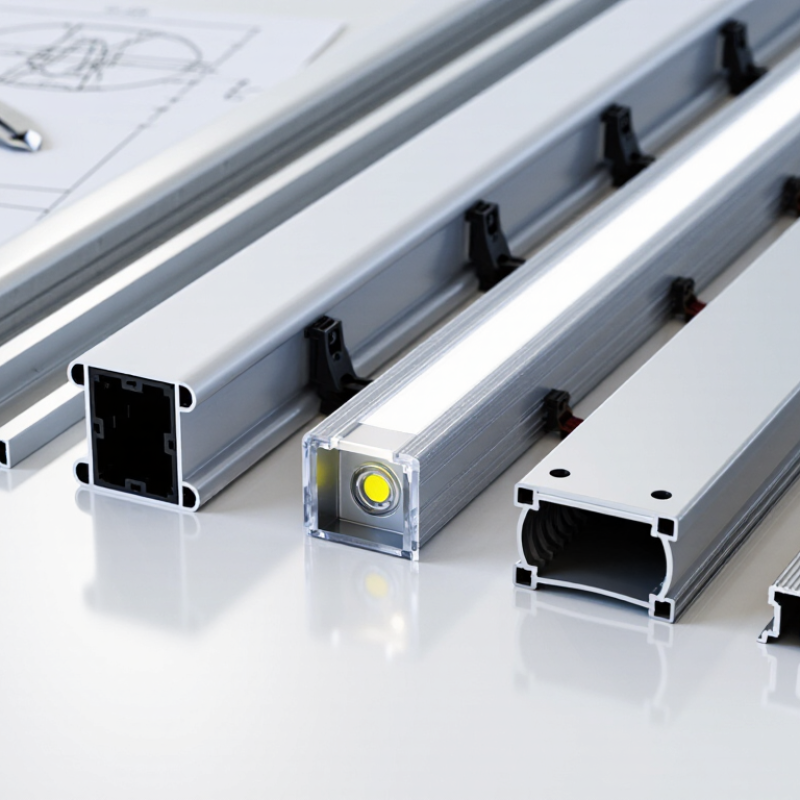
How to Choose LED Extrusion Profiles in 2026?
For 2026 projects, define the profile around performance goals, not appearance alone. Treat efficacy above 160 lm/W as a practical design benchmark. Confirm whether this figure means LED-source efficacy, luminaire efficacy, or delivered light. The U.S. Department of Energy distinguishes these measurements, and the difference can be substantial. A dense aluminum extrusion can remove heat efficiently, protecting output and reducing lumen depreciation. However, an oversized profile may increase cost without improving real performance. Measure the complete assembly, including the LED board, diffuser, driver, and operating temperature.
Tips: Request photometric data for the finished profile. Check testing conditions, ambient temperature, color temperature, and power input. Ask for thermal resistance data, not vague cooling claims. A clear diffuser may improve appearance but reduce delivered lumens. Test it.
Experienced installers also inspect fit before ordering long runs. Verify the channel width, mounting method, wire space, and diffuser retention. For recessed profiles, allow room for uneven surfaces and thermal expansion. For suspended systems, evaluate weight and connection points. High efficacy can still produce uncomfortable glare if the diffuser is poorly selected. Use beam control, adequate spacing, and suitable shielding. I would also question every “160 lm/W” claim. It may describe a laboratory source, not the installed product. That distinction is easy to miss. A small pilot installation can reveal hot spots, color shifts, and unexpected losses before the final specification is locked.
| Profile Application | Typical Installation | Recommended Aluminum Profile Size | Typical LED Strip Power | Thermal Management Priority | Recommended Diffuser | Typical Protection Level | Estimated Optical Efficiency | Best-Fit Efficacy Strategy | Primary Selection Consideration |
|---|---|---|---|---|---|---|---|---|---|
| Low-Profile Surface Mount | Cabinet lighting, shelves, furniture, display cases and shallow architectural details | Approximately 8–12 mm wide × 8–10 mm high | 4.8–9.6 W/m | Medium Use an aluminum body and avoid enclosing high-power LED strips in small cavities. |
Frosted or opal polycarbonate diffuser for glare reduction | Usually IP20; higher protection requires a sealed construction | Approximately 75–90%, depending on diffuser and LED spacing | Use high-efficacy LEDs, adequate LED pitch and low-loss wiring; keep operating temperature controlled. | Available depth, visual appearance and prevention of visible LED dots |
| Standard Surface-Mount Profile | Ceilings, walls, furniture fronts and continuous linear decorative lighting | Approximately 16–20 mm wide × 10–15 mm high | 9.6–19.2 W/m | High A larger aluminum cross-section improves heat spreading and LED lifetime. |
Frosted, opal or 50%–70% transmission diffuser | IP20–IP44 in standard configurations | Approximately 80–92% | Choose a profile with sufficient internal volume for a high-density strip and thermal contact across the full mounting surface. | Balance heat dissipation, diffuser transmission and required brightness |
| Deep Recessed Profile | Plasterboard, millwork, ceilings and concealed architectural lines | Approximately 20–30 mm wide × 20–35 mm high | 14.4–24 W/m | High Deep profiles improve mixing distance and reduce hotspot visibility. |
Deep opal diffuser or recessed lens with wide beam distribution | IP20–IP44; sealing details determine higher ratings | Approximately 78–90% | Use greater diffuser-to-LED distance, accurate LED spacing and a high-efficacy constant-voltage system. | Recess depth, flange visibility, shadow gaps and maintenance access |
| Trimless Plaster-In Profile | Seamless gypsum, plasterboard and premium interior architectural details | Approximately 30–60 mm overall width × 25–40 mm overall depth | 9.6–19.2 W/m | High The profile must remain mechanically stable and provide a continuous thermal path. |
Opal diffuser, fabric-reinforced diffuser or recessed lens | Normally IP20; construction interfaces must be protected from moisture | Approximately 75–88% | Prioritize uniformity and low glare while reserving enough aluminum mass for the selected wattage. | Plaster compatibility, crack prevention and flush finishing quality |
| 45-Degree Corner Profile | Inside corners, under-cabinet applications, shelving and accent lighting | Approximately 16–20 mm wide × 16–20 mm high | 9.6–14.4 W/m | Medium Corner installation can restrict airflow, so surface contact and wattage control are important. |
Frosted diffuser with a 45-degree viewing direction | Usually IP20–IP44 | Approximately 78–90% | Direct light toward the task surface and select a diffuser that limits reflected glare. | Beam direction, corner geometry and cable routing |
| Pendant or Suspended Profile | Linear suspended luminaires, offices, retail spaces and hospitality interiors | Approximately 30–80 mm wide × 50–100 mm high | 14.4–30 W/m | High The larger body supports passive cooling and can accommodate drivers, reflectors or multiple LED rows. |
Opal diffuser, microprismatic diffuser or direct/indirect optical system | Usually IP20–IP44 | Approximately 82–94% | Use a high-transmission optical system, efficient driver and carefully controlled operating temperature. | UGR, direct/indirect distribution, structural suspension and driver integration |
| High-Output Deep Profile | Commercial linear lighting, task lighting and high-brightness architectural installations | Approximately 30–50 mm wide × 30–60 mm high | 19.2–38.4 W/m | Very High Use a substantial aluminum heat sink, proper mounting and temperature verification. |
High-transmission diffuser, lens or reflector system | IP20–IP44 unless specifically sealed | Approximately 85–95% | Target system efficacy above 160 lm/W only when LED efficacy, driver efficiency, optical transmission and thermal conditions support it together. | Measured luminaire efficacy, thermal test data and allowable surface temperature |
| Outdoor Sealed Profile | Exterior façades, covered walkways, landscape details and wet-location linear lighting | Approximately 20–40 mm wide × 20–40 mm high | 9.6–24 W/m | High Sealing materials can reduce heat transfer; allow for drainage, expansion and condensation control. |
UV-stabilized polycarbonate diffuser or sealed lens | IP65–IP67 when correctly assembled and tested | Approximately 70–88% | Use corrosion-resistant aluminum, efficient LEDs and a sealed design without excessive diffuser loss. | UV exposure, water ingress, corrosion, cable glands and thermal expansion |
| Walk-Over or Heavy-Duty Profile | Floor lines, stairs, pedestrian areas and recessed architectural details | Approximately 25–50 mm wide × 20–35 mm high | 9.6–19.2 W/m | High The metal housing must provide both heat dissipation and mechanical load transfer. |
Impact-resistant diffuser or lens, often with a protective cover | IP65–IP67 when properly sealed | Approximately 65–85% | Prioritize durability and safe operating temperature; optical losses may be necessary for impact protection. | Load rating, slip resistance, impact resistance, drainage and replacement access |
| Flexible or Curved Profile | Columns, circular features, curved furniture and free-form architectural surfaces | Approximately 10–20 mm wide × 8–20 mm high | 4.8–14.4 W/m | Medium Check the minimum bend radius and ensure the installation surface can conduct heat. |
Flexible opal diffuser or silicone-based optical cover | IP20–IP67 depending on construction | Approximately 65–88% | Use low-to-moderate wattage, close LED spacing and a flexible system rated for the required bend radius. | Minimum bend radius, surface adhesion, thermal path and serviceability |
| Refrigerated or Low-Temperature Profile | Cold rooms, refrigerated displays and low-ambient commercial applications | Approximately 16–30 mm wide × 12–30 mm high | 4.8–14.4 W/m | Application-Specific LEDs may operate efficiently at low temperature, but seals, adhesives and plastics must also be rated for it. |
Food-safe or application-rated diffuser where required | IP54–IP67 depending on the enclosure | Approximately 75–90% | Verify starting performance, material compatibility, condensation control and driver operating range. | Ambient temperature, condensation, cleaning chemicals and material certification |